Financing
The EU contributes to the innovation, sustainability and safety of waterway transport and waterway infrastructure through the funding and financing programmes Connecting Europe Facility, Horizon Europe, LIFE, the Innovation Fund, the Recovery and Resilience Facility and the EU Structural and Investment Funds. A number of projects can be consulted on the projects page.
Connecting Europe Facility
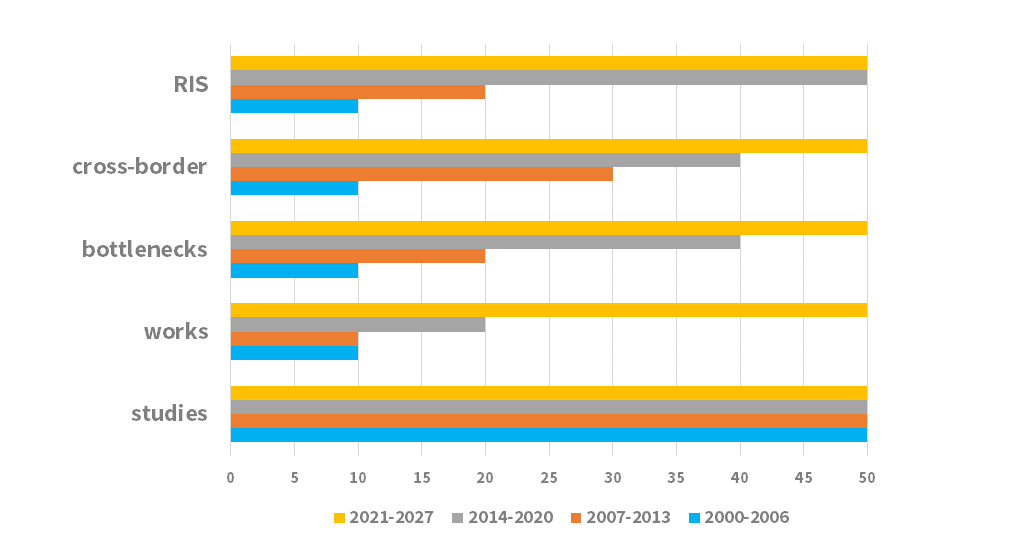
The EU institutions approved in 2021 the EU budget for 2021-2027. Under the 2nd Connecting Europe Facility, the maximum co-financing rate for inland waterway studies and works increased to up to 50%, and the maximum rate in cohesion countries remains at 85%.
The Connecting Europe Facility (CEF) has co-funded and continues to co-fund numbers of inland waterway infrastructure projects. In its proposal for the period 2028-2034, the Commission, plans to increase the budget but only to co-fund large cross-border projects. Moreover, it has removed most of waterway sections of the list of projects of common interest with cross-border dimension. Limiting future support exclusively to large cross‑border projects is a mistake as it overlooks a fundamental reality: transport infrastructure only works as a network, and a network is only as strong as its weakest link. Even a short national segment that is non‑compliant or non‑operational can undermine the efficiency, reliability, and competitiveness of an entire corridor, neutralising the benefits of major cross‑border investments.
National bottlenecks do not remain national in their impact. They ripple across borders, slowing down traffic, increasing costs, and reducing the attractiveness of inland waterways as a transport mode. This is particularly critical in inland waterway transport, where around 75% of volumes move across borders and where bypassing problematic stretches is rarely possible. In such a system, national projects are often the decisive enabler of cross‑border transport, not an optional complement.
These projects are also indispensable for achieving good navigation status and for climate‑proofing the network—both prerequisites for a resilient, future‑ready transport system. Waterway users consistently underline that reliability is the first and non‑negotiable condition for shifting more cargo to inland waterways. Without targeted investment in national bottlenecks, that reliability cannot be guaranteed.
Sustained support for national‑level infrastructure is therefore not a secondary priority; it is a strategic necessity for unlocking the full potential of Europe’s inland waterway cross-border corridors.
CEF general envelope: max. co-financing rates in %
What is the Connecting Europe Facility (CEF) and why is it important?
- CEF is the EU funding instrument to achieve trans-European networks.
- CEF Transport will have co-financed projects with a total budget of 24.05 billion euro in 2014-2020. 5.58% has been allocated to inland waterways in 2014-2019. CEF also enables investment in the implementation of new technologies and innovation, and it supports synergies between transport, telecommunications and energy, which is relevant for digitalisation and decarbonisation of transport.
- CEF2 is the successor programme for the period 2021-2027 with an overall budget of €33.71 billion, including for transport: €25.81 billion. Max. co-financing for waterways is up to 50% for the general envelope, up to 85% for the cohesion envelope..
Horizon Europe programme
The EU research and development programmes have co-funded and the current Horizon Europe continues to co-fund numbers of inland waterway projects to support policy coordination, to research alternative fuels and new vessels concepts, to prepare digitalisation and automation.
The current programme also co-funds research into climate adaptation and resilience. INE advocates increased attention and investment in this topic. Climate resilient waterways are essential for sustainable transport and safe water functions. More research and development is essential to develop effective nature based and flexible solutions for the different river basins with navigable waterways across the EU. Developing synergies with other sectors is also paramount to avoid negative cascading effects and maladaptation.
Taxonomy as incentive for sustainable transition
It is absolutely fundamental to direct public and private investments towards sustainable projects to achieve the EU climate goals. By classifying environmentally sustainable economic activities and providing criteria to what they should comply with, the EU taxonomy can enable the scale-up of sustainable investments. In the field of inland waterways, it is an opportunity to combine climate mitigation and adaptation, modal shift and environmental sustainability.
INE advocates two changes to the taxonomy climate change delegated act :
- Create a level playing field between rail and waterway infrastructure with regard to the scope of eligible activities in the taxonomy climate delegated act.
- The taxonomy climate delegated act currently excludes dredging from the scope of eligible activities for climate mitigation and adaptation activities in water infrastructure. Dredging activities are nevertheless necessary to implement climate change adaptation activities and nature based solutions. INE recommends establishing criteria for sustainable and responsible dredging in order to include this activity in line with the Integrated Sediment Management Guidelines and good practices in the context of the Water Framework Directive.
Priorities for INE
To safeguard the performance of Europe’s inland waterway network, the proposal for the 3rd Connecting Europe Facility (CEF) must be strengthened. Two amendments are essential:
- National waterway projects that are critical for cross‑border and port‑hinterland connectivity must remain eligible. Corridor performance depends on every segment functioning reliably; excluding national links would undermine the very cross‑border flows CEF aims to support.
- All waterway sections included under the 2nd CEF must be retained. Removing previously recognised sections would create gaps, weaken network coherence, and jeopardise long‑term investment planning for authorities and operators.
These adjustments ensure that CEF continues to support a fully connected, resilient and competitive inland waterway system—one capable of delivering on Europe’s transport, industrial, climate and security ambitions.