Green energy
EU path towards net-zero emissions
The European Green Deal aims to reduce greenhouse gas emissions by at least 55% by 2030. By 2050, Europe aims to become the world’s first climate neutral continent. This target is enshrined in law in the EU Climate Law.
In the EU Sustainable Transport Investment Plan (STIP) of 2025, the Commission states that without mandatory targets in place, 90% of inland vessels and recreational craft will still use diesel. Diesel could be progressively be replaced by renewable drop-in fuels. The Commission calculates that the decarbonisation of the IWT and fisheries sectors will require around an additional 3.1 Mt, approximately, reaching a total of 23.1 Mt by 2035. The IWT sector estimates that an annual supply of 1.6 million tonnes of sustainable drop-in fuels will be required. The Commission will launch a study in 2026 to assess how to decarbonize the sector and identify possible regulatory changes which could contribute to the uptake of alternative fuels.
Decarbonisation of IWT within reach
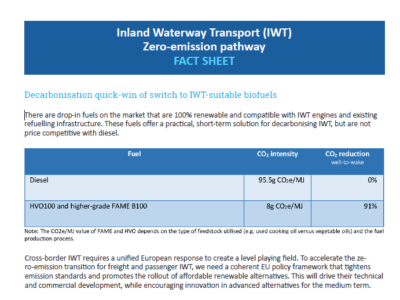
The IWT sector is clear about what is needed, and the moment has come to capture the low‑hanging fruit. A near‑term transition to almost zero greenhouse‑gas emissions in IWT is within reach through the broad uptake of sustainable drop‑in fuels, such as HVO100 or IWT‑compatible FAME B100. In parallel, air‑pollutant emissions can virtually be eliminated with appropriate after‑treatment technologies. The main obstacle is economic: operators cannot pass on the significantly higher cost of renewable drop‑in fuels to customers. This creates a competitive disadvantage compared to fossil‑fuel users.
Two measures are essential:
A unified and predictable EU regulatory framework that tightens emission norms and provides a clear zero‑emission pathway for the sector, creating the stable investment environment needed for fleet renewal and innovation.
A secure annual supply of 1.6 million tonnes of sustainable drop‑in fuels at diesel‑competitive prices, internalising CO₂ costs in fuel prices and establishing a level playing field. In combination with the desired decarbonization, this would strengthen IWT’s competitive position and reward its high energy efficiency.
Mid-term scenario
Relying solely on renewable drop-in fuels carries potential risks due to the possibility of supply and price volatility. Consequently, it is recommended to develop affordable and scalable alternative fuel solutions such as battery-electric propulsion, methanol and hydrogen to mitigate these risks and ensure resilience. These zero-emission energy solutions bring higher costs, both in terms of operation and capital. The key to overcoming implementation barriers will therefore be a combination of EU regulation and financial incentives; this will ensure legal certainty, foster investment and expand renewable fuel supply networks.
Alternative refuelling
In 2024, the EU adopted in 2024 the Alternative Fuels Infrastructure Regulation (AFIR) as part of the Fit for 55 Package. All TEN-T core inland ports should install by 2025 at least one shore-side electricity facility, and all TEN-T comprehensive inland ports should follow by 2030. This ensures zero-emission shipping in ports, but it requires sufficient grid capacity.
For sustainable drop-in fuels, the current refuelling infrastructure is fit for purpose. However, a successful transition to zero-emission battery‑electric propulsion depends on the timely rollout of alternative fuel and energy infrastructure. The most effective approach is coordinated, corridor‑based public–private deployment plans integrated into the EU transport corridors. This avoids the persistent “chicken‑and‑egg” dilemma in which vessel operators hesitate to invest without available infrastructure, while infrastructure providers delay investment without guaranteed vessel demand.
Priorities for INE
In the short term
- INE urges the EU to prioritise securing an annual supply of 1.6 million tonnes of sustainable drop‑in fuels at diesel‑competitive prices for the IWT sector, supported by a unified EU regulatory framework with a clear zero‑emission pathway and tightening of emission norms.
- It is crucial to establish an EU zero-emission pathway with binding intermediate targets. To achieve zero‑emission navigation in the medium term, efforts must already focus on developing scalable and affordable solutions to enable their timely market readiness and full‑scale deployment.
- Sufficient shore‑side electricity supply is essential to decarbonise inland vessels while at berth. Continued EU co‑financing through the Connecting Europe Facility and other funding programmes remains crucial to install these high‑cost facilities. Two additional challenges require attention: ensuring grid access at berth and securing adequate grid capacity.
In the mid term
- The national alternative fuel frameworks are welcome, but zero-emission energy infrastructure should definitely be deployed in a corridor approach. Installing alternative refuelling infrastructure at every inland port may turn out economically unviable and practically unnecessary. As inland ports are not evenly distributed along waterways, it could lead to oversupply in one region and undersupply in another.
- The European corridors should be used to plan and coordinate the development of green energy corridors that meet the needs of waterway users, industry, and geographical conditions. Integrating water transport early in the development of renewable energy value chains—from production to end user—offers a double advantage. The best way to achieve upscaling is to create transport-energy corridors linking ports as energy hubs. A relatively small sector such as inland navigation will certainly benefit from economies of scale and cooperation to accelerate its transition. In addition, its potential as a high-volume carrier of renewable energy can be exploited.
Corridors are well placed to help integrate industrial, transport and energy policy across sectors and corridors