Waterway infrastructure
Fit-for-future infrastructure
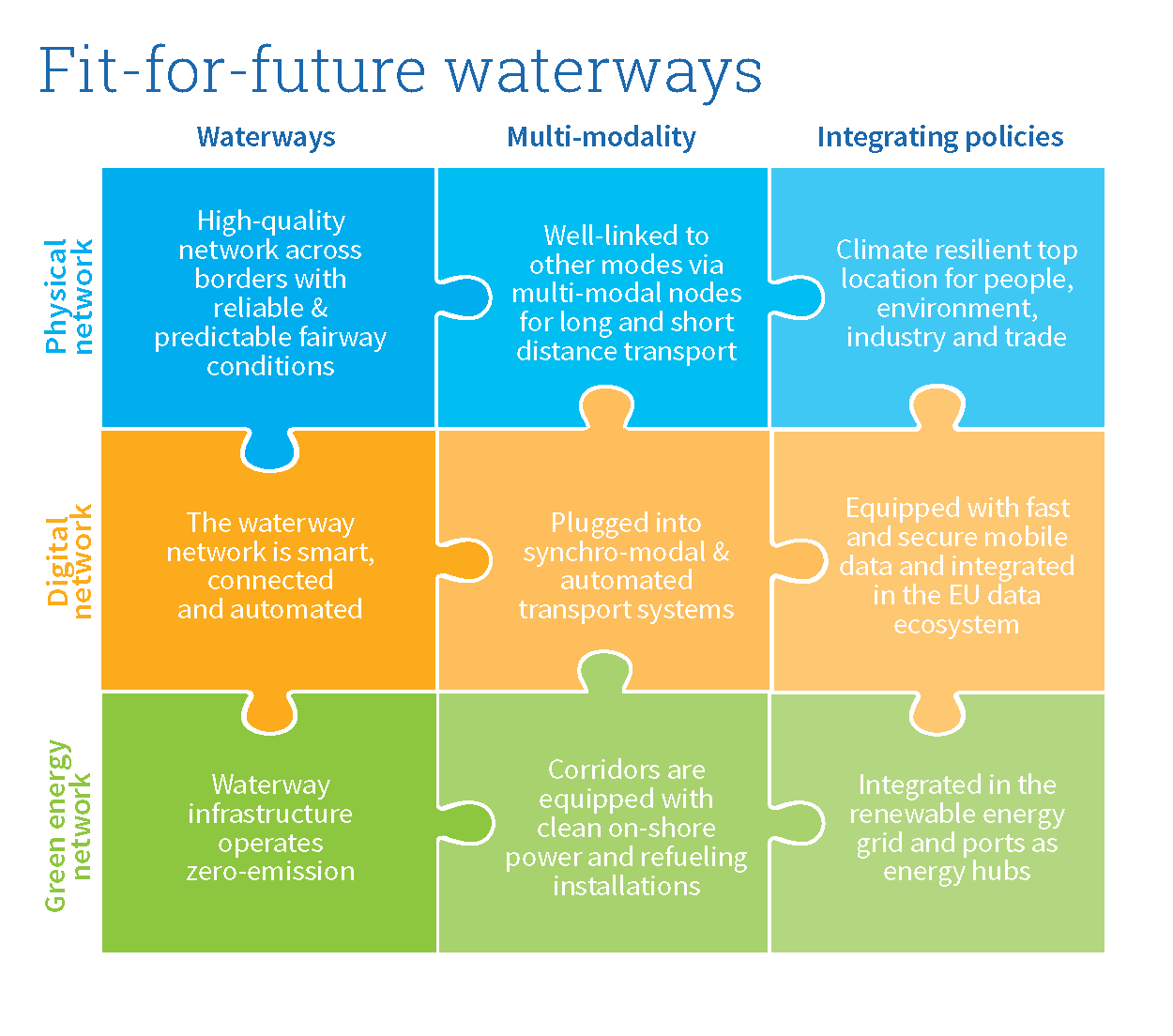
Reliable waterway infrastructure is the foundation for the future of transport over water. Without it, neither competitiveness nor a meaningful modal shift can be achieved. With climate change , reliability, resilience and redundancy are additional priorities. Waterway authorities therefore work to optimise the network across borders so that it functions as a seamless, safe and sustainable component of a fully integrated multimodal system, enabling users to choose the most efficient mobility and logistics mix. This ambition extends beyond the waterways themselves: it requires strong physical, digital and green‑energy connections to other modes, ensuring that the entire chain performs as one.
Waterways are also economic and social spaces. By maintaining and developing them, authorities create room for entrepreneurship in industry and sustainable recreation, innovation and employment on and along the water, strengthening regional economies and supporting sustainable growth.
Waterway authorities’ responsibilities reach far beyond transport. They are key actors in the management of water and critical infrastructure, in safeguarding natural habitats, enabling renewable energy generation, ensuring water supply, providing flood protection, and supporting recreation. Delivering infrastructure that is fit for the future therefore requires an integrated approach that aligns waterway management with EU policies on biodiversity, climate resilience, safety and security, industrial and circular economy, agriculture, tourism, energy and digitalisation.
Cross‑sectoral waterway investments that generate co‑benefits demand greater flexibility in EU programmes. The advantage is clear: such investments go beyond avoiding the costs of inaction, they contribute simultaneously to multiple EU policy goals and significantly increase EU added value, delivering a stronger return on public investment for the economy, the environment and society as a whole.
Quality, performance and resilience for more reliability
Waterway authorities aim not only to expand capacity where it is genuinely needed, but above all to strengthen the quality, performance, and safety of the network so that reliability, resilience, and predictability can be guaranteed. A high‑quality network depends on a life‑cycle approach: anticipating disruptions, recovering from them quickly, and extending the lifespan of existing infrastructure through renovation, modernisation, and innovation.
Digital support tools and increasing levels of automation play a growing role in optimising network management, improving traffic planning, and providing real‑time information to users.
The overarching objective is to create a flexible and integrated network of physical, digital and renewable energy refueling infrastructure of high quality.
What are Trans-European Networks (TENs) and why are they important?
- They aim to develop EU cross-border networks in the areas of transport, telecommunications and energy to support the EU internal market, reinforce economic and social cohesion, and ultimately connect Europe.
- The EU policy for trans-European for transport (TEN-T) aims at removing infrastructure bottlenecks by supporting investments in building new transport infrastructure or rehabilitating and upgrading the current one, including waterways, with 9 corridors as a backbone.

TEN-T: non-deterioration and reliability
The TEN-T regulation provides a comprehensive EU legal framework for developing sustainable, high‑performing, and climate‑resilient inland waterway infrastructure across Europe. It explicitly integrates the hydro‑morphological characteristics of rivers and introduces a life‑cycle approach to infrastructure management, ensuring that insufficient maintenance does not create new bottlenecks or undermine past investments.
Member States are required to guarantee Good Navigation Status by meeting minimum infrastructure requirements and service levels. These requirements will be further detailed through corridor‑specific implementing acts, ensuring consistency and operational reliability across the network.
A key element of the Regulation is the non‑deterioration principle. Member States must prevent any decline in the minimum standards and must also safeguard the current quality of those waterway sections that already exceed the minimum thresholds. This principle protects both the performance of the network and the value of previous investments.
The deadline for completing the core inland waterway network is 31 December 2030, underscoring the urgency for coordinated action, timely investment, and sustained maintenance efforts.

Milestones for the completion of the TEN-T network
- By 2030 – completion of the core TEN-T network at existing TEN-T standards
- By 2040 – completion of the extended core network according to the new standards to accelerate network completion in view of reaching the EU climate ambitions by 2050.
- By 2050 – completion of the entire Trans-European Transport Network, including the comprehensive network.
Connecting Europe Facility
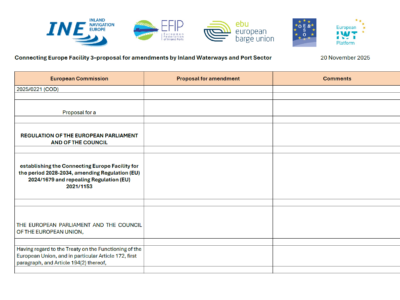
The Connecting Europe Facility (CEF) has co-funded and continues to co-fund a number of inland waterway infrastructure projects. The Commission plans a significant increase in budget in its CEF 3 proposal for the period 2028-2034, but the priority setting for inland waterways has substantially decreased compared to CEF 1 and CEF 2. Moreover, it has removed a significant number of the waterway sections from the list of projects of common interest with cross-border dimension. With the current challenges of climate change and geopolitical turmoil, this is a big risk. We need to climate proof our network and provide redundancy for the economic actors that rely on navigable waterways, counting inter alia the base industries that provide the essential materials on which countless other industries depend. Resolving waterway bottlenecks also benefits other water users thanks to the integrated nature of projects.
Limiting future support exclusively to large cross‑border projects is a mistake as it overlooks a fundamental reality: transport infrastructure only works as a network, and a network is only as strong as its weakest link. In the case of inland waterways, one critical segment that is non‑compliant or non‑operational can undermine the efficiency, reliability, and competitiveness of an entire corridor, neutralising the benefits of major cross‑border investments. Such bottlenecks do not remain limited in their impact. Since 75% of inland waterway traffic is international and bypassing problematic stretches is rarely possible, such bottlenecks ripple across borders, slowing down traffic, increasing costs, and reducing the effectiveness of the network. This is particularly critical in inland waterway transport. In such a system, small projects are often the decisive enabler of cross‑border transport, not an optional complement.
These projects are also indispensable for achieving good navigation status and for climate‑proofing the network—both prerequisites for a resilient, future‑ready transport system. Waterway users consistently underline that reliability is the first and non‑negotiable condition for shifting more cargo to inland waterways. Without targeted investment in critical inland waterway bottlenecks, this reliability cannot be guaranteed.
Sustained support for resolving critical inland waterways bottlenecks is therefore not a secondary priority; it is a strategic necessity for unlocking the full potential of Europe’s inland waterway cross-border corridors. We are working with policy makers to establish an instrument that enables the completion of the inland waterway core network and ensures future connectivity.
Priorities for INE
To safeguard the performance of Europe’s inland waterway network, the proposal for the 3rd Connecting Europe Facility (CEF) must be strengthened. Two amendments are essential:
- Waterway projects that are critical for cross‑border and port‑hinterland connectivity must remain eligible in every corridor under the next CEF (2028-2034). Corridor performance depends on every segment functioning reliably; excluding those bottlenecks would undermine the very cross‑border flows CEF aims to support.
- Ensuring that inland waterways get the right priority setting in the annex of the proposal. Removing previously recognised sections would create gaps, weaken network coherence, and jeopardise long‑term investment planning for authorities and operators.
These adjustments ensure that CEF continues to support a fully connected, resilient and competitive inland waterway system—one capable of delivering on Europe’s transport, industrial, climate and security ambitions.
Finally, the Commission must enable adaptive planning through more flexible programme design, because effective climate adaptation depends on emerging knowledge, continuous monitoring and systematic evaluation. European funding programmes should therefore accommodate phased implementation and adjustments as knowledge and risks evolve.